
A modular approach
Containerised solutions for small feedstocks, designed to adapt to site constraints and local needs.
- Modular configuration.
- Sizing based on available inputs.
- Plant expansion studied with the project.
Solutions
Containerised and hybrid anaerobic digestion units to treat biowaste where it is produced. A target design range from 500 kg to 10 t per day, depending on feedstock and feasibility.
Containerised solutions for small feedstocks, designed to adapt to site constraints and local needs.
A tank combined with containerised equipment to meet larger needs.
The energy benefit · trigeneration
Cogeneration produces electricity and heat from biogas. By adding an absorption chiller driven by part of the recovered heat, trigeneration can also produce cooling.
Production and potential savings are sized according to the available feedstock and needs. Actual savings are assessed during the feasibility study.
A concrete example to study
Imagine a small unit located near a shopping centre's service area. Sorted organic waste from restaurants, the fruit and vegetable section and other compatible shops is carried a short distance to an enclosed reception area.
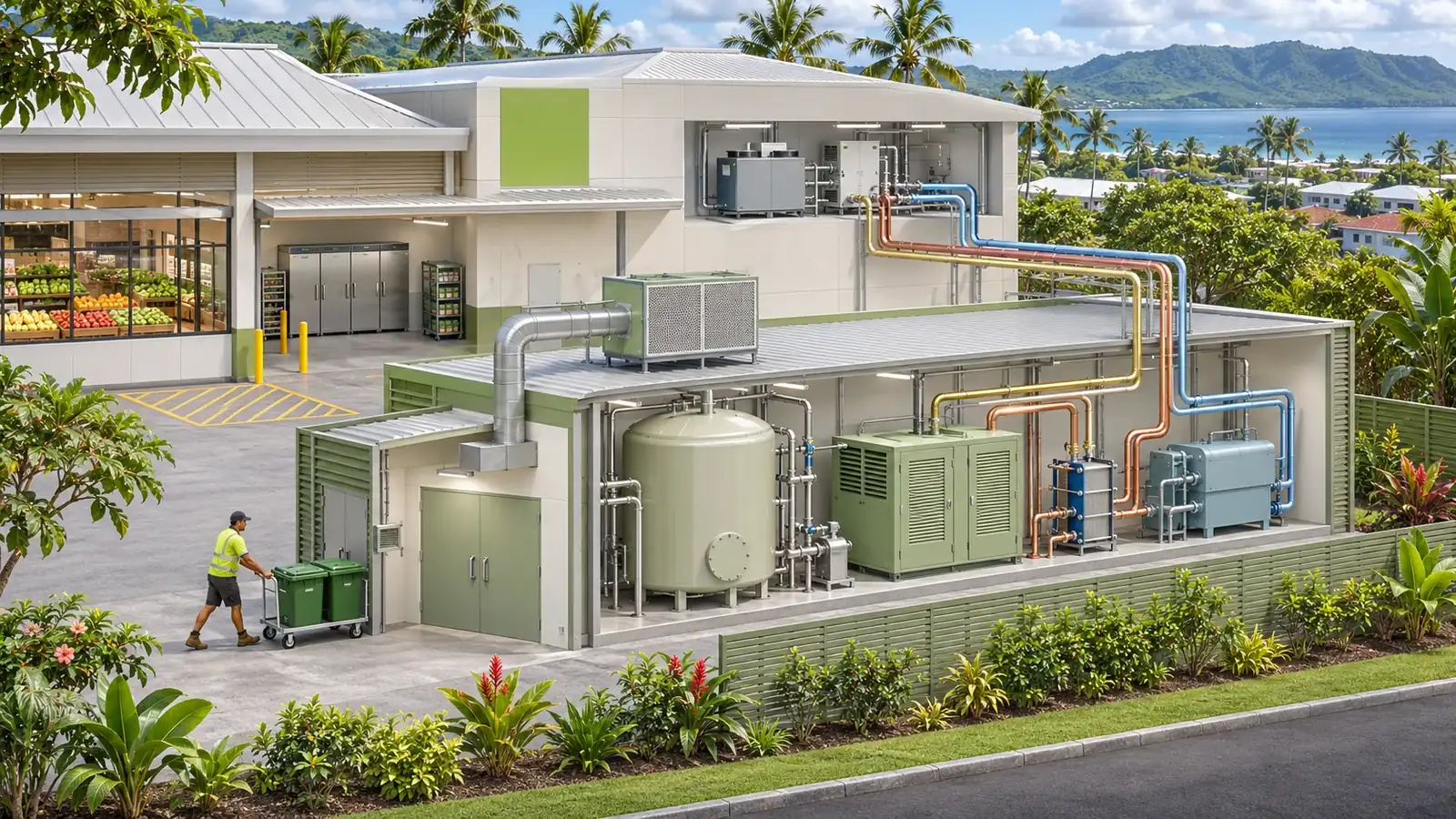
Supply part of the equipment and lighting, depending on output and grid connection arrangements.
Study hot water needs and other useful thermal uses, taking the process's own needs into account.
Produce chilled water for air conditioning. Fresh counters and cold rooms require a study of temperatures and suitable equipment.
Shorter trips for locally treated waste and lower energy purchases can reduce site costs. The balance also takes into account investment, operation, maintenance and back-up needs.
Operating example, with no guaranteed output or savings. Available volumes, actual heat and cooling demand and site feasibility determine the project's value.
Odour control from the design stage
Anaerobic digestion takes place in a closed digester. For reception and handling operations, the design provides for closed containers, an enclosed area and air extraction with suitable treatment, for example a biofilter.
Objective: avoid odour nuisance for local residents. The absence of odour cannot be guaranteed on the basis of a diagram alone: it depends on design, incoming materials and operation.
Study your shopping centre's potential ↗The principle
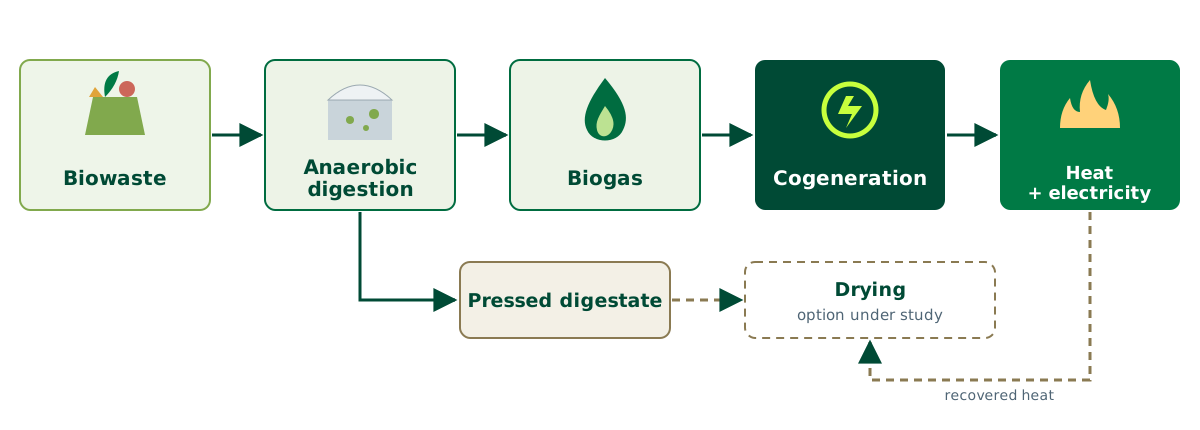
2 → Pressed digestate
Pressed digestate ⇢ Drying option under study
5 ⇢ Drying · recovered heat
Digestate is a second flow: its treatment and use are studied according to its characteristics and the applicable framework.
Immediate treatment is preferred; storage is kept for emergency situations.
The site's needs guide the configuration. Adding digesters or gas storage is studied case by case.
The design includes studying digestate pressing and then drying using cogeneration heat.
Optional add-on modules
A scalable approach: depending on the project's needs and feasibility, add-on modules can be studied to broaden the resources recovered and local uses.
Dedicated treatment and recovery options for these materials, alongside the main process.
CO₂ capture and recovery modules, studied to develop uses suited to the project.
Options studied case by case: their scope and integration conditions are defined during the project study.
A loop to develop
Study the use of heat and CO₂ from biogas recovery to support seaweed farming in a suitable system. Species selection and flow control are part of the design.
Seaweed can also be studied as an anaerobic digestion input, depending on its composition, salinity and quality. Seaweed that has accumulated pollutants requires a dedicated route, defined after analysis.
This coupling is a development ambition, to be validated by trials and a feasibility study. It does not involve any direct discharge of digestate into the marine environment.